
We use cookies on this website. Cookies help us deliver the best experience on our website. More about cookies
-
- Education
- Education
- Find programmes and courses
- Applications and admissions
- Tuition fees
- Scholarships
- Exchange studies at Malmö University
- Study Guidance
-
- After admission
- After admission
- Moving to Malmö
- Pre-orientation
- Arrival guide
-
- About studies at Malmö University
- Why choose Malmö University
- Understanding university studies
- Connect with our students
On the page -
- Research
- Research
- Find researchers and research
-
- Doctoral studies
- Doctoral studies
- Doctoral courses
-
- Doctoral schools
- Doctoral schools
- Adaptation of urban space through sustainable regeneration
- Culturally Empowering Education through Language and Literature
- Doctoral school: DACHE
- Education, Learning and Globalisation
- Finding ways in a time of great future challenges (FinnFram)
- Swedish National Graduate School in Science and Technology Education Research
- Learning in Multicultural Societal Contexts
- Pedagogy and Vocational Skills
- Relevancing Mathematics and Science Education (RelMaS)
- Sustainable Movement Education
- The National Research School for Professionals in Social Services
- Research subjects
-
- Research centres
- Research centres
- Biofilms Research Centre for Biointerfaces
-
- Citizen Health
- Citizen Health
- Kids in Action
- Imagining and Co-Creating Futures
- Institute for Urban Research
- Malmö Institute for Migration Studies
- Literacy and Inclusive Teaching
- Centre for Work Life Studies
- Sustainable Digitalisation Research Centre
- Centre for Sexology and Sexuality Studies
-
- Research publications
- Search for research publications in Diva
- Malmö University Press
-
- Research in focus
- Research in focus
- Focus: In the classroom
- Focus: The Election 2026
- Focus: A future with AI
- Focus: Climate and society
- Focus: Peace, democracy and human rights
- Focus: The mouth
- Focus: Migration
- Focus: Elite Sport, Football and Supporter Culture
- Focus: Perspectives on Malmö
- Focus: Loneliness
- Research events
- Participate in a research study
On the page -
- Collaboration & Innovation
-
- Levels of collaboration
-
- Local collaboration
- Muvah
- Co-Create Malmö
- Regional collaboration
- National collaboration
-
- International collaboration
- UNIC
- Innovation
- Collaboration with students
- Collaborate with researchers
- Culture collaboration
- Support Malmö University
- Alumni & Friends
On the page -
- About us
- About us
-
- Meet Malmö University
- The history of the University
- Malmö University in numbers
- Sustainability
-
- Management and organisation
-
- Faculty of Culture and Society
- Department of Global Political Studies
- School of Arts and Communication
- Department of Urban Studies
-
- Faculty of Education and Society
- Department of Childhood, Education and Society
- Department of Sport Sciences
- Department of Culture, Languages and Media
- Department of Natural Science, Mathematics and Society
- Department of Society, Culture and Identity
- Department of School Development and Leadership
- The Centre for Teaching and Learning (CAKL)
-
- Faculty of Technology and Society
- Department of Computer Science and Media Technology
- Department of Materials Science and Applied Mathematics
- Faculty of Odontology
- Management and decision-making paths
- Malmö University's strategy 2030
-
- Quality assurance work at the University
- Widened recruitment and participation
- University Dental Clinic
-
- Malmö Academic Choir and Orchestra
- Student work – video pieces
On the page -
- Contact
- Contact
- We help you with your questions
- Find your way around Malmö University
-
- News and press
- News and press
-
- Graphic manual
- Graphic manual
- Logo
- Colours
- Typography
- Visual language
- Film and live broadcasts
- Visit Malmö University
- Merchandise
- Supplier information and invoice management
- Whistleblowing
On the page
New research centre for game development confirmed
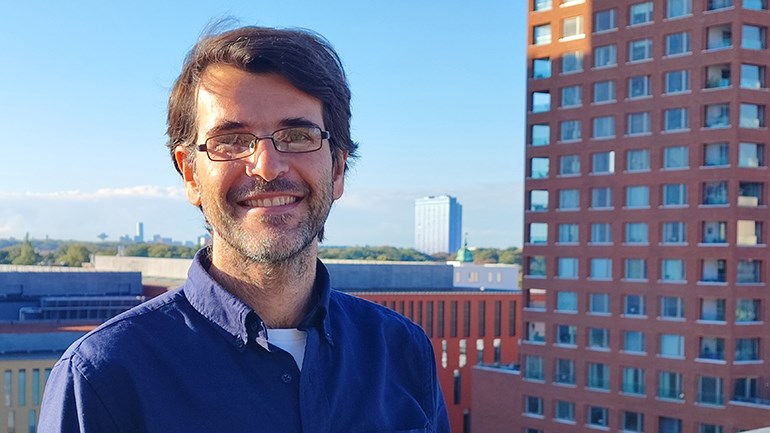
José Font, director of Malmö University's Game Lab, will lead the new research centre's work on research and innovation intelligence.
Building a bridge between the Swedish gaming industry and academic research is the main goal of the Game Development Research Centre. This five-year project brings together four Swedish universities and key players in the Swedish gaming industry.
In a groundbreaking project to strengthen Sweden's position in the global gaming industry, Malmö University, the University of Skövde, Blekinge Institute of Technology and Karlstad University will establish the Game Development Research Centre (GDRC).
Malmö is a significant European hub for game development, with a diverse and growing landscape of game studios ...
José Font
Malmö University's Game Lab will lead the GDRC's work on research and innovation intelligence, with the aim of deepening understanding of the interdisciplinary nature of game development research. The work, carried out in close collaboration with industry partners and international game development research centres, will build a strong common foundation for the development of the centre's research areas and doctoral courses.
The KK Foundation is the main financier of the initiative, investing over SEK 29 million in the project.
“Malmö is a significant European hub for game development, with a diverse and growing landscape of game studios, educational institutions, events, and a thriving ecosystem of communities. Malmö University plays a strategic, research-leading role in this dynamic environment. Thanks to the KK Foundation, we can now work together to strengthen the competitiveness of the Swedish game industry,” says José Font, director of Malmö University's Game Lab.
The Swedish gaming industry is dominated by micro-enterprises, with 90 per cent of gaming companies having fewer than ten employees. Despite their size, these small game studios can achieve great commercial success. GDRC aims to give successful micro-enterprises the opportunity to conduct long-term research and gain access to the very latest knowledge.
“Through GDRC, researchers and companies can collaborate from the very beginning of the research process. This makes it possible to identify research questions and produce results that are directly useful to companies and of great scientific value,” says Per Backlund, professor at the University of Skövde, where the research centre will be based.
Although the KK Foundation has extensive experience of financing collaborative projects between academia and industry, the GDRC initiative is unique in its kind.
“With this investment, we want to enable the development of new collaboration models that meet the unique conditions of the gaming industry. The investment lays the foundation for long-term collaborations that are crucial for Sweden to maintain and develop its strong position in game development,” says Eva Schelin, CEO of the KK Foundation.
Share Article