We use cookies on this website. Cookies help us deliver the best experience on our website. Read about cookies.
-
- Education
- Education
- Find programmes and courses
- Applications and admissions
- Tuition fees
- Scholarships
- Exchange studies at Malmö University
- Study Guidance
-
- After admission
- After admission
- Moving to Malmö
- Pre-orientation
- Arrival guide
-
- About studies at Malmö University
- Why choose Malmö University
- Understanding university studies
- Connect with our students
On the page -
- Research
- Research
- Find researchers and research
-
- Doctoral studies
- Doctoral studies
- Doctoral courses
-
- Doctoral schools
- Doctoral schools
- Adaptation of urban space through sustainable regeneration
- Culturally Empowering Education through Language and Literature
- Doctoral school: DACHE
- Education, Learning and Globalisation
- Finding ways in a time of great future challenges (FinnFram)
- Swedish National Graduate School in Science and Technology Education Research
- Learning in Multicultural Societal Contexts
- Pedagogy and Vocational Skills
- Relevancing Mathematics and Science Education (RelMaS)
- Sustainable Movement Education
- The National Research School for Professionals in Social Services
- Research subjects
-
- Research centres
- Research centres
- Biofilms Research Centre for Biointerfaces
-
- Citizen Health
- Citizen Health
- Kids in Action
- Imagining and Co-Creating Futures
- Institute for Urban Research
- Malmö Institute for Migration Studies
- Literacy and Inclusive Teaching
- Centre for Work Life Studies
- Sustainable Digitalisation Research Centre
- Centre for Sexology and Sexuality Studies
-
- Research publications
- Search for research publications in Diva
- Malmö University Press
- Research events
- Participate in a research study
On the page -
- Collaboration & Innovation
-
- Levels of collaboration
-
- Local collaboration
- Muvah
- Co-Create Malmö
- Regional collaboration
- National collaboration
-
- International collaboration
- UNIC
- Innovation
- Collaboration with students
-
- Collaborate with researchers
- Labs and facilities
- Culture collaboration
- Support Malmö University
- Alumni & Friends
- Malmö möts
On the page -
- About us
- About us
-
- Meet Malmö University
- The history of the University
- Malmö University in numbers
- Sustainability
-
- Management and organisation
-
- Faculty of Culture and Society
- Department of Global Political Studies
- School of Arts and Communication
- Department of Urban Studies
-
- Faculty of Education and Society
- Department of Childhood, Education and Society
- Department of Sport Sciences
- Department of Culture, Languages and Media
- Department of Natural Science, Mathematics and Society
- Department of Society, Culture and Identity
- Department of School Development and Leadership
- The Centre for Teaching and Learning (CAKL)
-
- Faculty of Technology and Society
- Department of Computer Science and Media Technology
- Department of Materials Science and Applied Mathematics
- Faculty of Odontology
- Management and decision-making paths
- Malmö University's strategy 2030
-
- Quality assurance work at the University
- Widened recruitment and participation
- University Dental Clinic
-
- Malmö Academic Choir and Orchestra
- Student work – video pieces
On the page -
On the page
The history of the University
Malmö University has emerged in a city characterised by change, and since its foundation in 1998 has developed into an urban institution of higher education with strong roots in both academic values and social relevance. The story begins at a time when Malmö was transforming from an industrial city into a city of knowledge – and the new university was tasked with providing education and research that would strengthen the region’s development.
A university shaped by change
Malmö University is a young university with its roots in a city that has undergone major changes. When Malmö University College was founded in 1998, Malmö was in the midst of a transition from an industrial city to a city of knowledge. The decline of the shipbuilding industry had altered the city’s identity and sense of optimism about the future, whilst at the same time new ideas were emerging about education, research and innovation as drivers of development.
The new university was established to meet a growing need for higher education in the region and to contribute to Malmö’s social and economic development. Degree programmes previously organised by other higher education institutions were brought together in Malmö, laying the foundations for a new, independent university right in the heart of the city.
The university’s history is therefore closely intertwined with Malmö’s own journey – from an industrial city to an international and sustainable city of knowledge.
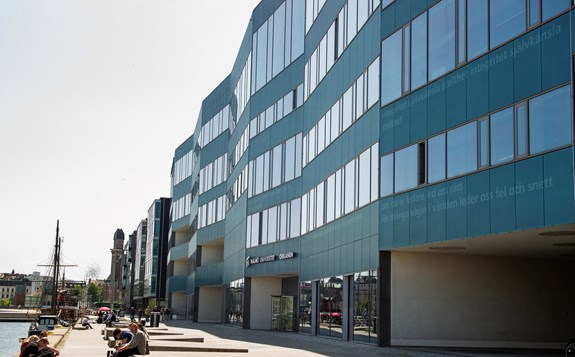
Malmö University now and then.
An urban university in the heart of Malmö
Unlike many traditional campus-based universities, Malmö University developed as an integral part of the urban environment. The university’s buildings were situated in the heart of Malmö, close to people, the world of work and community organisations.
This proximity to the city has shaped both research and education. Issues relating to democracy, migration, sustainability, health, culture and social justice have been central areas of focus from the outset. The university has also developed close partnerships with the public sector, civil society and the business community – both regionally and internationally.
Malmö’s diversity has been of great significance to the university’s development. Students and staff from different backgrounds and with varied experiences have contributed to an open and international environment where new perspectives take centre stage.
From University College to University
During its first two decades, Malmö University College grew rapidly. The number of degree programmes and research environments increased, while the institution established itself as a leading centre for research with a strong focus on societal challenges.
In 2018, Malmö University College was granted university status and became Malmö University. This marked a new stage in its development and strengthened its capacity to deliver research and education of a high international standard.
Today, Malmö University is one of Sweden's largest higher education institutions, with around 26,000 students across five faculties and a number of research centres.
Facts about Malmö University
Year
- 1948 – The School of Dentistry becomes Malmö’s first academic institution.
- 1959 – Malmö City Nursing School is founded. It later becomes the basis for the School of Nursing.
- 1960 – The Teacher Training College is established as one of the city’s largest educational institutions.
- 1983 – The School of Nursing is formed through the merger of nursing programmes.
- 1998 – Malmö University is established. It opens on 1 July with around 5,000 students.
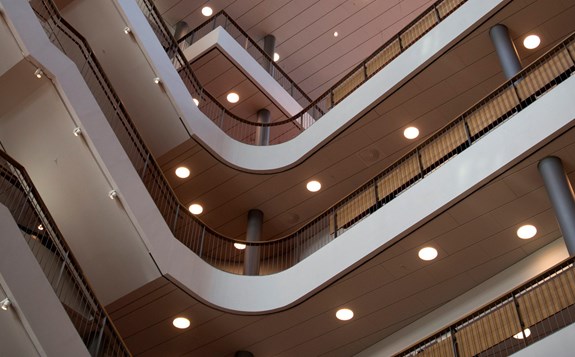
- 2005 – Orkanen is inaugurated, becoming the university’s largest building and library.
- 2011 – First doctoral degrees awarded by the university itself: Malmö University is granted the right to award doctoral degrees in several fields.
- 2015 – Niagara is inaugurated – a new hub for research, education and collaboration.
- 2018 – Malmö University is granted university status from 1 January.
Vice-Chancellors
- Per-Olof Glantz (1998–2002)
- Lennart Olausson (2002–2011)
- Stefan Bengtsson (2011–2015)
- Kerstin Tham (2015–2025)
- Mia Rönnmar (2025– )