We use cookies on this website. Cookies help us deliver the best experience on our website. More about cookies

-
- Education
- Education
- Find programmes and courses
- Applications and admissions
- Tuition fees
- Scholarships
- Exchange studies at Malmö University
- Study Guidance
-
- After admission
- After admission
- Moving to Malmö
- Pre-orientation
- Arrival guide
-
- About studies at Malmö University
- About studies at Malmö University
- Why choose Malmö University
- Understanding university studies
- Connect with our students
- Study at a national sports university
On the page -
- Research
- Research
- Find researchers and research
-
- Doctoral studies
- Doctoral studies
- Doctoral courses
-
- Doctoral schools
- Doctoral schools
- Adaptation of urban space through sustainable regeneration
- Culturally Empowering Education through Language and Literature
- Doctoral school: DACHE
- Education, Learning and Globalisation
- Finding ways in a time of great future challenges (FinnFram)
- Swedish National Graduate School in Science and Technology Education Research
- Learning in Multicultural Societal Contexts
- Pedagogy and Vocational Skills
- Relevancing Mathematics and Science Education (RelMaS)
- Sustainable Movement Education
- The National Research School for Professionals in Social Services
- Research subjects
-
- Research centres
- Research centres
-
- Biofilms Research Centre for Biointerfaces
- Biofilms Research Centre for Biointerfaces
- Water Science Lab
-
- Citizen Health
- Citizen Health
- Kids in Action
- Imagining and Co-Creating Futures
- Institute for Urban Research
- Malmö Institute for Migration Studies
- Literacy and Inclusive Teaching
- Centre for Work Life Studies
- Sustainable Digitalisation Research Centre
- Centre for Sexology and Sexuality Studies
-
- Research publications
- Research publications
- Search for research publications in Diva
- Malmö University Press
-
- Research in focus
- Research in focus
- Focus: In the classroom
- Focus: The Election 2026
- Focus: A future with AI
- Focus: Climate and society
- Focus: Peace, democracy and human rights
- Focus: The mouth
- Focus: Migration
- Focus: Elite Sport, Football and Supporter Culture
- Focus: Perspectives on Malmö
- Focus: Loneliness
- Research events
- Participate in a research study
On the page -
- Collaboration & Innovation
- Collaboration & Innovation
-
- Levels of collaboration
- Levels of collaboration
-
- Local collaboration
- Local collaboration
- Muvah
- Co-Create Malmö
- Regional collaboration
- National collaboration
-
- International collaboration
- International collaboration
- UNIC
- YERUN
- Innovation
- Collaboration with students
- Collaborate with researchers
- Culture collaboration
- Support Malmö University
On the page -
- About us
- About us
-
- Meet Malmö University
- Meet Malmö University
- The history of the University
- Malmö University in numbers
-
- Annual Academic Celebration
- Annual Academic Celebration
- Academic traditions
- Meet our new professors
- Meet our new doctors
- Honorary doctors
- To new doctors and promotor
- Sustainability
-
- Management and organisation
- Management and organisation
-
- Faculty of Culture and Society
- Faculty of Culture and Society
- Department of Global Political Studies
- School of Arts and Communication
- Department of Urban Studies
-
- Faculty of Education and Society
- Faculty of Education and Society
- Department of Childhood, Education and Society
- Department of Sport Sciences
- Department of Culture, Languages and Media
- Department of Natural Science, Mathematics and Society
- Department of Society, Culture and Identity
- Department of School Development and Leadership
- The Centre for Teaching and Learning (CAKL)
- Knowledge Centre for Educational Health in Schools (PHIS)
-
- Faculty of Technology and Society
- Faculty of Technology and Society
- Department of Computer Science and Media Technology
- Department of Materials Science and Applied Mathematics
- Faculty of Odontology
- Management and decision-making paths
- Malmö University's strategy 2030
-
- Quality assurance work at the University
- Quality assurance work at the University
- Widened recruitment and participation
- University Dental Clinic
-
- Malmö Academic Choir and Orchestra
- Malmö Academic Choir and Orchestra
- Student work – video pieces
On the page -
- Contact
- Contact
- We help you with your questions
- Find your way around Malmö University
- Visit Malmö University
-
- News and press
- News and press
-
- Graphic manual
- Graphic manual
- Logo
- Colours
- Typography
- Visual language
- Film and live broadcasts
- Merchandise
- Supplier information and invoice management
- Whistleblowing
On the page
Crowded front teeth reduce young people’s quality of life
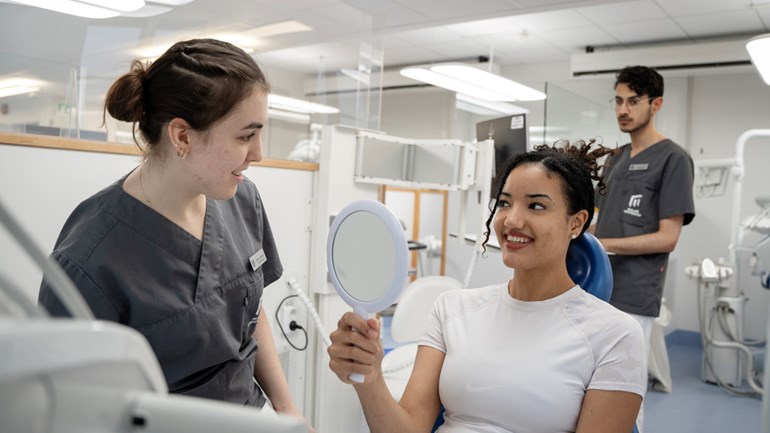
Malocclusions affect far more than teeth. They can influence young people's well-being, self-confidence, and quality of life during a critical period of social and psychological development.
In a study of 600 adolescents aged 12–19, Associate Professor Mikael Sonesson and colleagues at Malmö University found that oral health-related quality of life was significantly lower among girls and among young people with crowded front teeth. The findings underline the importance of providing timely orthodontic care to those most affected.
“The results may help to improve prioritisation within orthodontic care and give dentists a better understanding of which malocclusions have the greatest impact on young patients’ well-being,” says Sonesson.
The study is published in the European Journal of Orthodontics and was performed within the ‘Advancing Oral Health’ research profile. This work contributed to one of the main themes of the profile “Health Equity ensuring inclusive access to and provision of oral healthcare for all”.
“The profile provides more research time, a broad network of researchers, and opportunities to collaborate with other professional groups”, says Sonesson.
Previous research has shown that access to publicly funded orthodontic treatment is unevenly distributed across the country in terms of young people's gender and socioeconomic background. An ongoing project is therefore conducting a major study into how boys and girls experience malocclusions and the need for orthodontic treatments.
“Dental care for children and young people is funded by the taxpayers. It is therefore important that we produce relevant evidence to ensure this care is provided as effectively and equal as possible”, says Mikael Sonesson.
Share Article