Figuring out how messy the Milky Way is
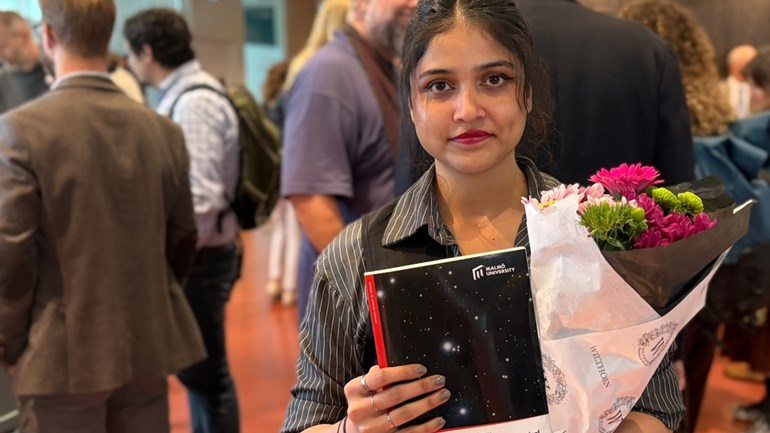
Astrophysicist Shilpa Bijavara Seshashayana has investigated the chemical history of the Milky Way’s disc by studying red giant stars in open clusters.
In her doctoral thesis, Shilpa Bijavara Seshashayana has studied how our galaxy, the Milky Way, has evolved chemically over time by analysing what are known as open star clusters.
“By measuring trace elements and the abundance of various chemical elements in star clusters we can understand when and where different parts of our galaxy were formed,” explains Bijavara Seshashayana, who completed her PhD at the Department of Materials Science and Applied Mathematics at Malmö University.
The Milky Way is messy, but at least now I know how to measure just how messy it is!
Shilpa Bijavara Seshashayana
Bijavara Seshashayana has investigated the chemical history of the Milky Way’s disc using high-resolution infrared spectroscopy of red giant stars in open star clusters. The spectroscopic results have been combined with the clusters’ ages, positions, and data from the Gaia space telescope to study chemical trends across the entire galactic disc.
“I have found that the chemical composition of open star clusters varies depending on both their age and their location within the Milky Way. Some of these patterns also suggest that stars and star clusters may move away from the regions where they originally formed during the galaxy’s evolution.”
She spent one year of her PhD studies at the Nordic Optical Telescope (NOT) on the Canary Island of La Palma, where she carried out space observations and operated the telescope. For around five nights each month, she was solely responsible for the instruments at the station, where her duties included ensuring that the liquid nitrogen required to keep the telescope cool was topped up.
“The year on La Palma gave me invaluable knowledge of how to plan observations, collect astronomical data and understand how other researchers work. But I would say that the greatest experience and insight came on an existential level.”
She plans to continue studying how the Milky Way formed, using the large datasets available from current and future astronomical surveys. “The Milky Way is messy, but at least now I know how to measure just how messy it is!’ says Bijavara Seshashayana.
Read the thesis: Open Clusters and the Chemical Evolution of the Galactic Disc