Substantial grant to fund state-of-the-art microscope
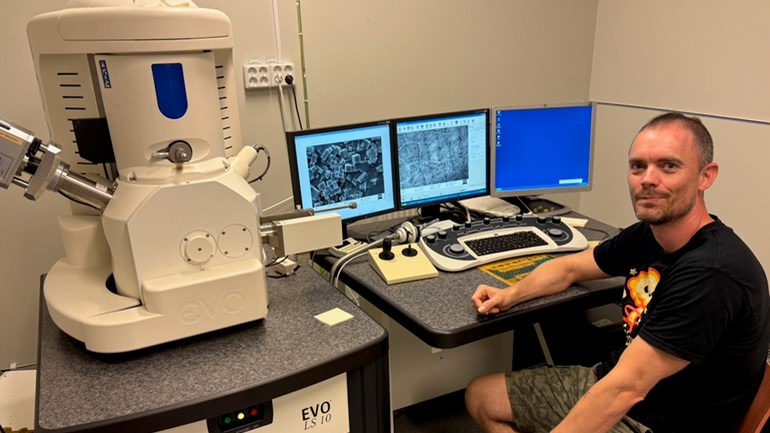
Researcher Peter Falkman at the current scanning electron microscope. The new one to be purchased will have up to ten times greater magnification.
A grant of 5 million kronor from the Crafoord Foundation will enable the purchase of an advanced scanning electron microscope that will make a significant difference to all natural science research at Malmö University.
“A scanning electron microscope of this kind will be usable for at least the next ten years and means that we will be able to meet 90 to 95 per cent of our imaging needs internally here at Malmö University. The equipment we have today is often just below the threshold of what is required, meaning we can only see hints of the structures of certain nanoparticles.
An imaging infrastructure not only meets current and future needs but also acts as a driving force in bringing together the research of all three faculties.
“A new microscope, which gives us up to ten times greater magnification, opens up a whole new world for us,” says researcher Peter Falkman, who is the laboratory manager at the Department of Biomedical Sciences.
A scanning electron microscope (SEM) scans the surface and looks a few nanometres (one billionth of a metre) into the sample. In many cases, image analysis using such a microscope is the primary method employed, for example, in studies of the distribution of bacteria in biofilms or the deposition of nanoparticles on surfaces.
Over the past year, the Department of Biomedical Sciences at the Faculty of Health and Society has initiated a process to organise and establish a coherent infrastructure for its research equipment. The aim is to promote research collaboration within Malmö University, as well as with other higher education institutions, the regional business and public sectors.
In connection with the application, Falkman and his co-applicant Johan Engblom reached out widely and asked researchers at the Faculty of Technology and Society and the Faculty of Odontology what kinds of projects they were currently working on or planning that could benefit from a scanning electron microscope.
“An imaging infrastructure not only meets current and future needs but also acts as a driving force in bringing together the research of all three faculties. Links with the surrounding business community are also fostered, as the instruments will be available through Open Lab South, which will serve as a gateway for establishing new contacts,” says Falkman.
Ahead of the application to the Crafoord Foundation, Malmö University initially ran an internal process in which each faculty was invited to submit two project proposals. Of these ten proposals, two were then selected centrally, with funding for a scanning electron microscope being one of the two prioritised by the management.
“The application naturally gains a whole new level of strength and prestige when it is put forward centrally by Malmö University. And the microscope we are set to acquire will benefit all natural science research at the University. The hope is that the microscope will be up and running within a year,” says Falkman.
At present, there are already at least 25 active and funded research projects that will benefit greatly from the new scanning electron microscope. Here are ten of them:
- Adaptable surfaces for sensing, inhibition and fundamental studies of bacterial adhesion, HS (Vetenskapsrådet)
- Biobarriers - Health, Disorders and Healing (SP3 Ex vivo models, SP4 Microbiota, SP5 Sensing), HS (KK-stiftelsen)
- Exploring Water-Solid Surface Interactions for Efficient and Sustainable Cleaning, HS,(Water Science Lab, Sandberg Development)
- Revealing melanoma biomarkers on the surface of skin, HS (Mats Paulssons foundation)
- Amorphous TiNiSn for efficient green energy generation, TS (Olle Engkvists stiftelse)
- Hierarchical nanoengineered assemblies of titania (Hi-NEAT), TS (European Commission - MSCA Postdoctoral Fellowship)
- Hyperspectral, multidimensional Imaging with Neutrons to explore material processes and processing for a sustainable society, TS (Vetenskapsrådet)
- Impact of material properties on long-term retention, OD (KK-stiftelsen)
- Targeting peri-implantitis: new materials and antibiotic-coated implants for microbiome modulation and tissue integration, OD (Österlunds Stiftelse, KK-stiftelsen)
- Microstructure, crystal structure, and mechanical and optical properties of multilayer zirconium dioxide depending on sintering program, OD (external PhD project).