We use cookies on this website. Cookies help us deliver the best experience on our website. More about cookies

-
- Education
- Education
- Find programmes and courses
- Applications and admissions
- Tuition fees
- Scholarships
- Exchange studies at Malmö University
- Study Guidance
-
- After admission
- After admission
- Moving to Malmö
- Pre-orientation
- Arrival guide
-
- About studies at Malmö University
- About studies at Malmö University
- Why choose Malmö University
- Understanding university studies
- Connect with our students
On the page -
- Research
- Research
- Find researchers and research
-
- Doctoral studies
- Doctoral studies
- Doctoral courses
-
- Doctoral schools
- Doctoral schools
- Adaptation of urban space through sustainable regeneration
- Culturally Empowering Education through Language and Literature
- Doctoral school: DACHE
- Education, Learning and Globalisation
- Finding ways in a time of great future challenges (FinnFram)
- Swedish National Graduate School in Science and Technology Education Research
- Learning in Multicultural Societal Contexts
- Pedagogy and Vocational Skills
- Relevancing Mathematics and Science Education (RelMaS)
- Sustainable Movement Education
- The National Research School for Professionals in Social Services
- Research subjects
-
- Research centres
- Research centres
-
- Biofilms Research Centre for Biointerfaces
- Biofilms Research Centre for Biointerfaces
- Water Science Lab
-
- Citizen Health
- Citizen Health
- Kids in Action
- Imagining and Co-Creating Futures
- Institute for Urban Research
- Malmö Institute for Migration Studies
- Literacy and Inclusive Teaching
- Centre for Work Life Studies
- Sustainable Digitalisation Research Centre
- Centre for Sexology and Sexuality Studies
-
- Research publications
- Research publications
- Search for research publications in Diva
- Malmö University Press
-
- Research in focus
- Research in focus
- Focus: In the classroom
- Focus: The Election 2026
- Focus: A future with AI
- Focus: Climate and society
- Focus: Peace, democracy and human rights
- Focus: The mouth
- Focus: Migration
- Focus: Elite Sport, Football and Supporter Culture
- Focus: Perspectives on Malmö
- Focus: Loneliness
- Research events
- Participate in a research study
On the page -
- Collaboration & Innovation
- Collaboration & Innovation
-
- Levels of collaboration
- Levels of collaboration
-
- Local collaboration
- Local collaboration
- Muvah
- Co-Create Malmö
- Regional collaboration
- National collaboration
-
- International collaboration
- International collaboration
- UNIC
- Innovation
- Collaboration with students
- Collaborate with researchers
- Culture collaboration
- Support Malmö University
On the page -
- About us
- About us
-
- Meet Malmö University
- Meet Malmö University
- The history of the University
- Malmö University in numbers
- Sustainability
-
- Management and organisation
- Management and organisation
-
- Faculty of Culture and Society
- Faculty of Culture and Society
- Department of Global Political Studies
- School of Arts and Communication
- Department of Urban Studies
-
- Faculty of Education and Society
- Faculty of Education and Society
- Department of Childhood, Education and Society
- Department of Sport Sciences
- Department of Culture, Languages and Media
- Department of Natural Science, Mathematics and Society
- Department of Society, Culture and Identity
- Department of School Development and Leadership
- The Centre for Teaching and Learning (CAKL)
- Knowledge Centre for Educational Health in Schools (PHIS)
-
- Faculty of Technology and Society
- Faculty of Technology and Society
- Department of Computer Science and Media Technology
- Department of Materials Science and Applied Mathematics
- Faculty of Odontology
- Management and decision-making paths
- Malmö University's strategy 2030
-
- Quality assurance work at the University
- Quality assurance work at the University
- Widened recruitment and participation
- University Dental Clinic
-
- Malmö Academic Choir and Orchestra
- Malmö Academic Choir and Orchestra
- Student work – video pieces
On the page -
- Contact
- Contact
- We help you with your questions
- Find your way around Malmö University
- Visit Malmö University
-
- News and press
- News and press
-
- Graphic manual
- Graphic manual
- Logo
- Colours
- Typography
- Visual language
- Film and live broadcasts
- Merchandise
- Supplier information and invoice management
- Whistleblowing
On the page
FACULTY OF ODONTOLOGY | Lecture
Inaugural Lecture: Helena Fransson – When Cavities Go Deep: New Insights into Cavities and Root Canal Treatment
Wednesday 14 October, 14:00 - 14:45
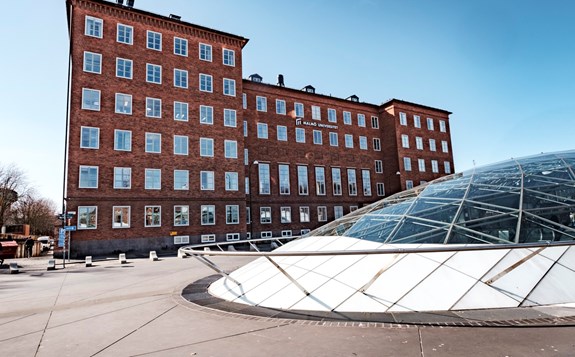
The restaurant on the ground floor of Orkanen, Nordenskiöldsgatan 10, Malmö

Welcome to Professor Helena Fransson’s inaugural lecture
"When Cavities Go Deep: New Insights into Cavities and Root Canal Treatment"
Keeping one’s own teeth is of great importance for both oral health and quality of life. In her lecture, Professor Helena Fransson will discuss how research—by tracking hundreds of thousands of root-filled teeth in national registries over time—can reveal how teeth can be preserved longer, what risks are associated with different treatment options, and how the future of dental care can become both more evidence-based and cost-effective.
Refreshments will be served.
The lecture will be held in Swedish.
You can find a link to the live streaming on the Swedish page.
Tooth decay is one of the most common public health problems. When tooth decay becomes deep, there is a risk that the tooth’s pulp will be damaged. By using gentler treatment methods for deep tooth decay, the need for root canal treatment can be reduced in many cases.
The fundamental purpose of a root canal is to preserve the tooth and avoid having to extract it. But how successful are we really at achieving this in the long term? Being able to keep one’s own teeth is important, since individuals’ perceived oral health—and thus their overall health—is closely linked to retaining their teeth.
In Sweden, we have a unique opportunity to track the results of dental treatments through national registries. We can thus study the outcomes for the nearly 250,000 teeth that underwent root canal treatment just over ten years ago. For most of these teeth, the treatment has been successful in the sense that they are still present in the mouth. However, some have been lost over time. The risk that a root-filled tooth will later need to be extracted is influenced, among other factors, by the patient’s age, the tooth’s location in the mouth, and how the final restoration of the tooth crown was performed. Since patients themselves bear a large portion of the cost of dental care, financial circumstances can also influence treatment choices. Patients with lower socioeconomic status may therefore forgo—or not be offered—more costly options for tooth restoration.
Even if a root-filled tooth remains in the mouth, this does not necessarily mean that it is completely healthy. It is relatively common for such teeth to show signs of residual disease, even though the patient usually has no symptoms or only mild discomfort. In some cases, the tooth can lead to a painful acute infection, and, more rarely, a more serious infection may develop. How these root-filled teeth—where the risk of future emergency procedures or serious infection is unknown—should be managed is not self-evident. A dentist’s decision to refrain from further treatment of a root-filled tooth showing signs of residual disease is complex and is often influenced by several factors beyond the tooth’s biological status.
In order for both dentists and patients to make well-informed decisions about these root-filled teeth, we need to address the prevailing uncertainty. More knowledge is needed about the risks, benefits, and costs associated with different treatment strategies. Such knowledge is essential for providing care that is both evidence-based and cost-effective.

Share Event