We use cookies on this website. Cookies help us deliver the best experience on our website. Read about cookies.
-
- Education
- Education
- Find programmes and courses
- Applications and admissions
- Tuition fees
- Scholarships
- Exchange studies at Malmö University
- Study Guidance
-
- After admission
- After admission
- Moving to Malmö
- Pre-orientation
- Arrival guide
-
- About studies at Malmö University
- Why choose Malmö University
- Understanding university studies
- Connect with our students
On the page -
- Research
- Research
- Find researchers and research
-
- Doctoral studies
- Doctoral studies
- Doctoral courses
-
- Doctoral schools
- Doctoral schools
- Adaptation of urban space through sustainable regeneration
- Culturally Empowering Education through Language and Literature
- Doctoral school: DACHE
- Education, Learning and Globalisation
- Finding ways in a time of great future challenges (FinnFram)
- Swedish National Graduate School in Science and Technology Education Research
- Learning in Multicultural Societal Contexts
- Pedagogy and Vocational Skills
- Relevancing Mathematics and Science Education (RelMaS)
- Sustainable Movement Education
- The National Research School for Professionals in Social Services
- Research subjects
-
- Research centres
- Research centres
- Biofilms Research Centre for Biointerfaces
-
- Citizen Health
- Citizen Health
- Kids in Action
- Imagining and Co-Creating Futures
- Institute for Urban Research
- Malmö Institute for Migration Studies
- Literacy and Inclusive Teaching
- Centre for Work Life Studies
- Sustainable Digitalisation Research Centre
- Centre for Sexology and Sexuality Studies
-
- Research publications
- Search for research publications in Diva
- Malmö University Press
-
- Research in focus
- Research in focus
- Focus: In the classroom
- Focus: The Election 2026
- Focus: A future with AI
- Focus: Climate and society
- Focus: Peace, democracy and human rights
- Focus: The mouth
- Focus: Migration
- Focus: Elite Sport, Football and Supporter Culture
- Focus: Perspectives on Malmö
- Focus: Loneliness
- Research events
- Participate in a research study
On the page -
- Collaboration & Innovation
-
- Levels of collaboration
-
- Local collaboration
- Muvah
- Co-Create Malmö
- Regional collaboration
- National collaboration
-
- International collaboration
- UNIC
- Innovation
- Collaboration with students
-
- Collaborate with researchers
- Labs and facilities
- Culture collaboration
- Support Malmö University
- Alumni & Friends
- Malmö möts
On the page -
- About us
- About us
-
- Meet Malmö University
- The history of the University
- Malmö University in numbers
- Sustainability
-
- Management and organisation
-
- Faculty of Culture and Society
- Department of Global Political Studies
- School of Arts and Communication
- Department of Urban Studies
-
- Faculty of Education and Society
- Department of Childhood, Education and Society
- Department of Sport Sciences
- Department of Culture, Languages and Media
- Department of Natural Science, Mathematics and Society
- Department of Society, Culture and Identity
- Department of School Development and Leadership
- The Centre for Teaching and Learning (CAKL)
-
- Faculty of Technology and Society
- Department of Computer Science and Media Technology
- Department of Materials Science and Applied Mathematics
- Faculty of Odontology
- Management and decision-making paths
- Malmö University's strategy 2030
-
- Quality assurance work at the University
- Widened recruitment and participation
- University Dental Clinic
-
- Malmö Academic Choir and Orchestra
- Student work – video pieces
On the page -
On the page
Exercise relieves jaw pain – but the effect isn’t the same for everyone
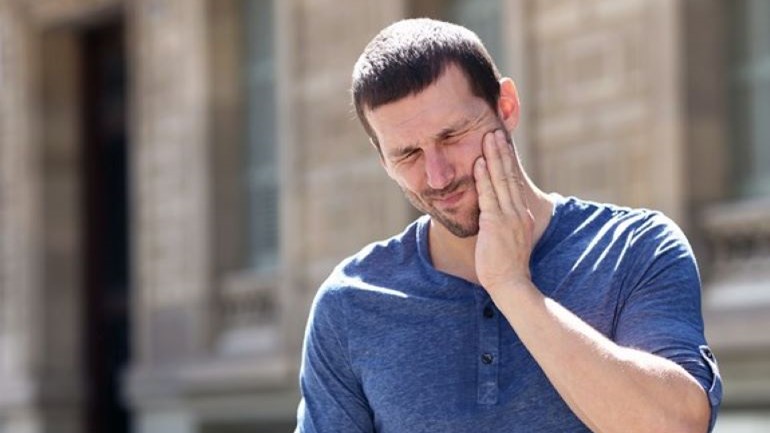
One in ten Swedes lives with chronic pain in the jaw, face or mouth. A new doctoral thesis now provides in-depth insight into how this pain affects those affected and why pain-relieving jaw exercises have varying effects on different people.
This type of pain, known as orofacial pain, can make it difficult to chew, speak and eat. For many, it affects both their well-being and quality of life in the form of constant ache and fatigue in the jaw muscles. The condition is particularly common among women and young adults.
Although jaw training is the most common form of treatment for restoring function and relieving pain, we have so far had surprisingly little knowledge of how the brain and nervous system react to this training.
Nikola Stanisic
The most common cause of these problems is temporomandibular dysfunction (TMD) – a collective term for pain and disorders in the jaw joints and jaw muscles. Often, it involves clenching or grinding the teeth or tensing the jaws without being aware of it.
“As many people do this without realising it, these behaviours can be difficult for a dentist to detect and assess,” says Nikola Stanisic, a PhD student at the Faculty of Odontology, Malmö University.
Exercise is a common form of treatment; the aim is to improve function, reduce pain and strengthen the jaw system’s ability to cope with stress. Stanisic’s thesis now shows that the effect of this exercise varies depending on the individual’s pain level and the strain placed on the jaws in everyday life.
He has arrived at these findings by investigating, on the one hand, how pain and overuse affect jaw function and jaw muscle activity, and, on the other hand, how the masticatory system responds to exercise and how the brain and nervous system adapt to this exercise – a process known as neuroplasticity.
In addition, he has conducted a systematic review of previous relevant research on pain and neuroplasticity which, however, has rarely focused on the masticatory system.
“Although jaw training is the most common form of treatment for restoring function and relieving pain, we have so far had surprisingly little knowledge of how the brain and nervous system react to this training,” says Stanisic.
In the studies, participants underwent a short jaw training programme. It was found that training improved jaw function in both pain-free individuals and those with pain – but that pain and strain affected the degree of improvement. The brain’s motor system was altered by training, but adaptation was slower in people who frequently clench their teeth or tense their jaws, a condition known as bruxism.
The study showed that there is a clear link between how people themselves perceive their jaw tension and the actual muscle activity. People experiencing pain had longer periods of low-intensity muscle activity. This likely reduces the muscles’ ability to recover.
“I hope the results will contribute to a better understanding of TMD pain and that clinicians will look not only at the pain, but also at how patients use their jaws in everyday life. With this knowledge, we can design more accurate and personalised treatment for jaw pain,” adds Stanisic.
Related pages
Share Article