
We use cookies on this website. Cookies help us deliver the best experience on our website. Read about cookies.
-
- Education
- Education
- Find programmes and courses
- Applications and admissions
- Tuition fees
- Scholarships
- Exchange studies at Malmö University
- Study Guidance
-
- After admission
- After admission
- Moving to Malmö
- Pre-orientation
- Arrival guide
-
- About studies at Malmö University
- Why choose Malmö University
- Understanding university studies
- Connect with our students
On the page -
- Research
- Research
- Find researchers and research
-
- Doctoral studies
- Doctoral studies
- Doctoral courses
-
- Doctoral schools
- Doctoral schools
- Adaptation of urban space through sustainable regeneration
- Culturally Empowering Education through Language and Literature
- Doctoral school: DACHE
- Education, Learning and Globalisation
- Finding ways in a time of great future challenges (FinnFram)
- Swedish National Graduate School in Science and Technology Education Research
- Learning in Multicultural Societal Contexts
- Pedagogy and Vocational Skills
- Relevancing Mathematics and Science Education (RelMaS)
- Sustainable Movement Education
- The National Research School for Professionals in Social Services
- Research subjects
-
- Research centres
- Research centres
- Biofilms Research Centre for Biointerfaces
-
- Citizen Health
- Citizen Health
- Kids in Action
- Imagining and Co-Creating Futures
- Institute for Urban Research
- Malmö Institute for Migration Studies
- Literacy and Inclusive Teaching
- Centre for Work Life Studies
- Sustainable Digitalisation Research Centre
- Centre for Sexology and Sexuality Studies
-
- Research publications
- Search for research publications in Diva
- Malmö University Press
- Research events
- Participate in a research study
On the page -
- Collaboration and Innovation
-
- Levels of collaboration
-
- Local collaboration
- Muvah
- Co-Create Malmö
- Regional collaboration
- National collaboration
-
- International collaboration
- UNIC
- Innovation
- Collaboration with students
-
- Collaborate with researchers
- Labs and facilities
- Culture collaboration
- Support Malmö University
- Alumni & Friends
- Malmö möts
On the page -
- About us
- About us
-
- Faculties and departments
-
- Faculty of Culture and Society
- Department of Global Political Studies
- School of Arts and Communication
- Department of Urban Studies
-
- Faculty of Education and Society
- Department of Childhood, Education and Society
- Department of Sport Sciences
- Department of Culture, Languages and Media
- Department of Natural Science, Mathematics and Society
- Department of Society, Culture and Identity
- Department of School Development and Leadership
- The Centre for Teaching and Learning (CAKL)
-
- Faculty of Technology and Society
- Department of Computer Science and Media Technology
- Department of Materials Science and Applied Mathematics
- Faculty of Odontology
- University Dental Clinic
-
- Find and contact Malmö University
- Visit Malmö University
-
- News and press
- News and press
- Graphic manual
- Map of the buildings (Google Maps)
- Merchandise
- Supplier information and invoice management
- Whistleblowing
- We'll help with your questions
- Management and decision-making paths
-
- Malmö University's strategy 2030
- Sustainability
- Widened recruitment and participation
- Quality assurance work at the University
-
- Malmö Academic Choir and Orchestra
- Student work – video pieces
-
- The University in a troubled world
- Campus total defence
On the page
Research celebrates first woman to take the floor of the Swedish Parliament
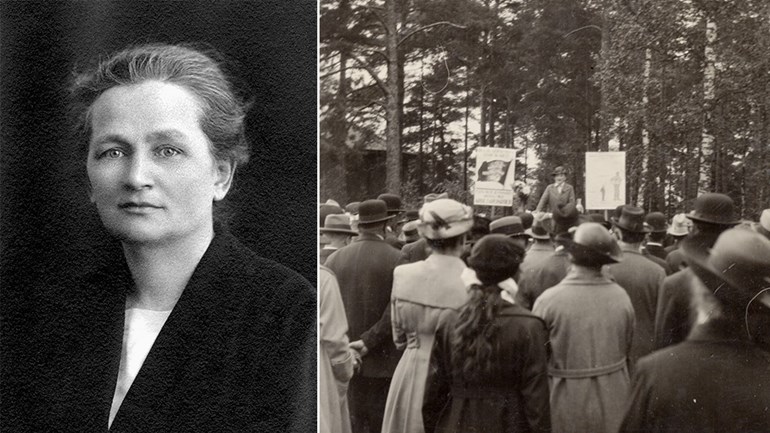
Agda Östlund, the first female speaker of the Swedish Parliament. Image: Labour Movement Archives and Library
On March 11, 1922, Agda Östlund became the first woman ever to take the floor of the Swedish Parliament. In his thesis, Magnus Gustafson has analysed her rhetoric at five important events to show how her voice became significant in the fight for women's rights and social justice.
“If you really want something, you get courage,” said Agda Östlund to a childhood friend after speaking at the People's House in Stockholm.
What we can learn is that we need to organise ourselves in order for something to happen.
Magnus Gustafson
“This reflects quite well the driving forces she had as a politician,” says Gustafson.
By analysing rhetorical situations in her career, he examines in his thesis what strategies she used and what roles she took. These include the work she did during the suffrage struggle, in the 1921 election campaign, in her first speech in the Swedish Parliament, in the debate on alcohol prohibition and in the debate on abortion in 1938.
In his work, Gustafson has identified factors that made Agda Östlund's rhetoric successful: she adapted her speech to the situation and used historical and literary references; she could change her perspective to criticize norms and assumptions; she took on different roles to deal with conflicts around class and gender.
Östlund grew up in a working-class home in Köping in the 1870s. She became active in the temperance movement and eventually an important part of the movement for women's suffrage. From 1922 to 1938, she sat in the Parliament for the Social Democrats and was involved in issues of social justice, maternity care, housing policy and abortion legislation.
Gustafson himself grew up in Köping, but it was several decades before he heard of Agda Östlund. It was only during a visit to the Labour Movement Archives and Library in Stockholm that he discovered her story.
“During the time I've been working on my thesis, she has become more recognised. In connection with the centenary of women being allowed to stand as candidates for the Riksdag, she was highlighted alongside other contemporary female politicians.”
Gustafson strives to better understand the time in which she lived. He also emphasises the importance of highlighting the role of working-class women, as they have often been overshadowed in the history of the labour movement.
“Telling her story is also telling the story of the emergence of popular movements. What we can learn is that we need to organise ourselves in order for something to happen. The strong flame that she had, and which burned for a long time, I believe can inspire today's generations on the international stage.”
Text by: Wilma Haneke Brodd
Share Article