
His thesis is the very first in applied physics at Malmö University
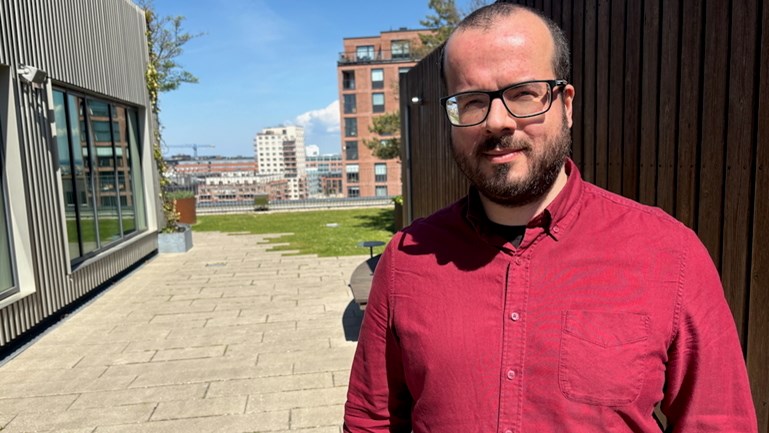
Grzegorz Sadowski has completed his PhD at the Department of Materials Science and Applied Mathematics.
Grzegorz Sadowski has investigated how the thermoelectric properties of thin films change when subjected to stress. And his doctoral thesis is the first in the field of applied physics at the Department of Materials Science and Applied Mathematics at Malmö University.
Thermoelectric thin films have proven to be a promising power source for portable devices, and an alternative to batteries; offering a continuous and long-lasting flow of electricity. They also provide a silent, off-grid and reliable solution for electricity generation when exposed to temperature differences.
As thin films have a small cross-sectional area, it is possible to study high stresses by applying relatively small forces. This makes them not only practical to work with when it comes to creating microdevices and sensors for the Internet of Things, but also for studying the effects of stress,” says Sadowski.
Although previous studies point to the potential benefits of controlled stresses, this is often overlooked when describing a material’s thermoelectric properties, according to Sadowski. He explores this in his doctoral thesis: Thermoelectric Mg3Bi2 and TiNiSn thin films under intrinsic and extrinsic stress.
As part of his research he has, among other things, studied the effects of stress on the thermoelectric properties of Mg3Bi2-based films
“A moderate level of stress proved to be optimal for the Mg3Bi2 material, as it improved its properties compared with the unstressed sample. The difference in properties resulting from the stress was quite significant, which explains why a material can exhibit a wide range of values under seemingly identical conditions.”
He has also studied the thermomechanical stability of amorphous TiNiSn layers (a chemical compound made of titanium (Ti), nickel (Ni), and tin (Sn), which are flexible in the amorphous state but brittle in the crystalline state:
“Crystallisation occurred at 300 degrees Celsius, which is over 200 degrees lower than the reported crystallisation temperature for stress-free TiNiSn. The degree of crystallisation appears to be proportional to the applied stress and fairly stable under constant forces,” says Sadowski.
What is the most important lesson or experience you have gained during your PhD?
“That there is always more to learn and that you can never start preparing too early. Nobody knows everything, and there is no shame in asking questions – especially about things you feel you should already know. The sooner you start asking questions, the less embarrassed you feel.”
Why did you choose to become a researcher and what are your next steps?
“My thesis was on thin films, and I wanted to delve deeper and learn more about the subject. Doing research is also a great way to network with people with similar interests. I’m currently looking for a postdoctoral position and am looking forward to working with other materials and applications.”