
We use cookies on this website. Cookies help us deliver the best experience on our website. Read about cookies.
-
- Education
- Education
- Find programmes and courses
- Applications and admissions
- Tuition fees
- Scholarships
- Exchange studies at Malmö University
- Study Guidance
-
- After admission
- After admission
- Moving to Malmö
- Pre-orientation
- Arrival guide
-
- About studies at Malmö University
- Why choose Malmö University
- Understanding university studies
- Connect with our students
On the page -
- Research
- Research
- Find researchers and research
-
- Doctoral studies
- Doctoral studies
- Doctoral courses
-
- Doctoral schools
- Doctoral schools
- Adaptation of urban space through sustainable regeneration
- Culturally Empowering Education through Language and Literature
- Doctoral school: DACHE
- Education, Learning and Globalisation
- Finding ways in a time of great future challenges (FinnFram)
- Swedish National Graduate School in Science and Technology Education Research
- Learning in Multicultural Societal Contexts
- Pedagogy and Vocational Skills
- Relevancing Mathematics and Science Education (RelMaS)
- Sustainable Movement Education
- The National Research School for Professionals in Social Services
- Research subjects
-
- Research centres
- Research centres
- Biofilms Research Centre for Biointerfaces
-
- Citizen Health
- Citizen Health
- Kids in Action
- Imagining and Co-Creating Futures
- Institute for Urban Research
- Malmö Institute for Migration Studies
- Literacy and Inclusive Teaching
- Centre for Work Life Studies
- Sustainable Digitalisation Research Centre
- Centre for Sexology and Sexuality Studies
-
- Research publications
- Search for research publications in Diva
- Malmö University Press
- Research events
- Participate in a research study
On the page -
- Collaboration & Innovation
-
- Levels of collaboration
-
- Local collaboration
- Muvah
- Co-Create Malmö
- Regional collaboration
- National collaboration
-
- International collaboration
- UNIC
- Innovation
- Collaboration with students
-
- Collaborate with researchers
- Labs and facilities
- Culture collaboration
- Support Malmö University
- Alumni & Friends
- Malmö möts
On the page -
- About us
- About us
-
- Faculties and departments
-
- Faculty of Culture and Society
- Department of Global Political Studies
- School of Arts and Communication
- Department of Urban Studies
-
- Faculty of Education and Society
- Department of Childhood, Education and Society
- Department of Sport Sciences
- Department of Culture, Languages and Media
- Department of Natural Science, Mathematics and Society
- Department of Society, Culture and Identity
- Department of School Development and Leadership
- The Centre for Teaching and Learning (CAKL)
-
- Faculty of Technology and Society
- Department of Computer Science and Media Technology
- Department of Materials Science and Applied Mathematics
- Faculty of Odontology
- University Dental Clinic
- Management and decision-making paths
-
- Malmö University's strategy 2030
- Sustainability
- Widened recruitment and participation
- Quality assurance work at the University
-
- Malmö Academic Choir and Orchestra
- Student work – video pieces
-
- The University in a troubled world
- Campus total defence
On the page -
- Contact
- Contact
- We'll help with your questions
- Find your way around Malmö University
-
- News and press
- News and press
-
- Graphic manual
- Graphic manual
- Logo
- Colours
- Typography
- Visual language
- Film and live broadcasts
- Visit Malmö University
- Merchandise
- Supplier information and invoice management
- Whistleblowing
On the page
Learn how to improve dental care, while brushing your teeth!
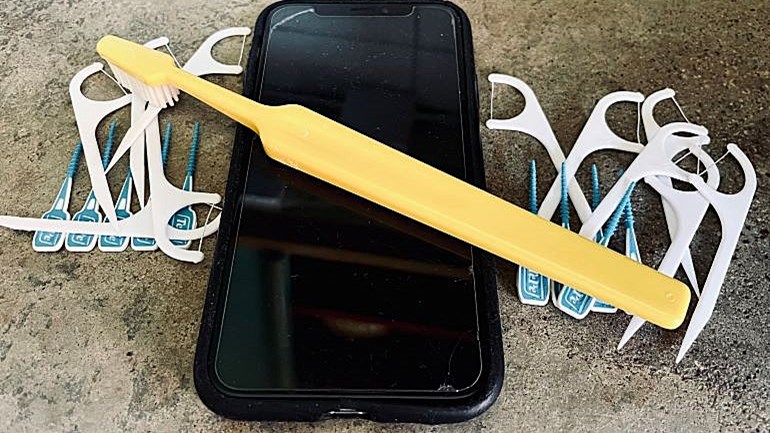
“We understand that many people look at their mobile phones when they brush their teeth. The phone is therefore an excellent channel for using the camera to provide real-time instructions for personalised dental care,” says Matin Farzad.
A personalised guide on your mobile phone that shows you exactly how to use your toothbrush, interdental brushes and dental floss is being developed by researchers at the Faculty of Odontology at Malmö University.
“With this app as a coach, we hope that more people will improve their oral care routines and at the same time save on society's resources,” says Aleksandar Milosavljevic, a specialist dentist and associate senior lecturer.
If this proves to have the desired outcome, we will have a preventive treatment that is much more cost-effective and better for patients than reactive and reparative care.
Aleksandar Milosavljevic
Every adult knows that they should brush and floss their teeth daily: it is also something we are often reminded of when we visit the dentist or hygienist, often in the form of an educational leaflet on oral health care.
“Everyone brushes their teeth, but few do it properly and even fewer clean between their teeth daily. As a result, many individuals are at risk of gum disease later in life, such as gingivitis and periodontitis, which in the worst case can lead to tooth loss,” continues Milosavljevic.
The research team therefore thought about how they could make it easier for people to take care of their oral health. One solution was to develop an app for mobile phones with bespoke guides that pedagogically show people how to clean their teeth.
“We understand that many people look at their mobile phones when they brush their teeth. The phone is therefore an excellent channel for using the camera to provide real-time instructions for personalised dental care,” says Matin Farzad, who is also part of the research team.
Several steps remain to be taken in the project before the app can be available. A first step is to evaluate the effectiveness of the app through clinical studies where patients receive the personalised instructions. The instructions are recommended by the dentist and visualised in augmented reality in the app over the patient's own teeth.
The research team sees several development opportunities, for example to integrate the app with existing medical record systems in dentistry. However, this is a larger project that will be developed at a later stage.
“We now need more time to conduct several randomised clinical trials involving hundreds of patients. This is to see if we can bring about behavioural change in patients accessing the app and thus prevent or mitigate the development of serious gum disease.
“If this proves to have the desired outcome, we will have a preventive treatment that is much more cost-effective and better for patients than reactive and reparative care,” says Milosavljevic.

Share Article