The shark’s complex body regulation was presented at a water conference

Henrik Vinther Sörensen’s research focuses on how sharks prevent water from escaping from their bodies, which would otherwise occur at high salinity levels or high water pressure in the surrounding sea.
Six water researchers from Malmö University took part in a major water conference in Stockholm. One of them is Henrik Vinther Sörensen, who is interested in how sharks regulate their body water content when exposed to extreme conditions in the sea.
The conference, Water Anomalies – Origin and Implications, focused on the anomalous properties and reactions of water compared with similar molecules. For example, water has an unusually high boiling point and high surface tension compared with other molecules of the same size, and its peak density at four degrees Celsius is also something that stands out.
“These anomalies are partly linked to the molecule’s structure and how it interacts with other water molecules. But we don’t really know why it behaves exactly as it does, and that is precisely what makes water so fascinating,” says Vinther Sörensen, a member of the Water Science Lab research group at the Department of Biomedical Sciences.
His research focuses on how sharks prevent water from escaping from their bodies – which would otherwise occur at high salt levels or high-water pressure in the surrounding sea – by producing the substance urea.
“Urea is an osmolyte, which is an organic compound that organisms use to regulate osmotic pressure and maintain fluid balance in their cells. A side effect is that urea destabilises certain proteins in the body, so to avoid this, the shark also produces another osmolyte called TMAO, which, conversely, stabilises the proteins,” explains Vinther Sörensen.
His research shows that urea makes water molecules less structured, whilst TMAO makes the water more structured.
According to Vinther Sörensen, one of the hottest topics in water research today is that liquid water exists in two phases. The theory is that one phase, HDL (High Density Liquid), is more compact and resembles gas in its properties. The other phase, LDL (Low Density Liquid), is less compact and more reminiscent of ice in its properties.
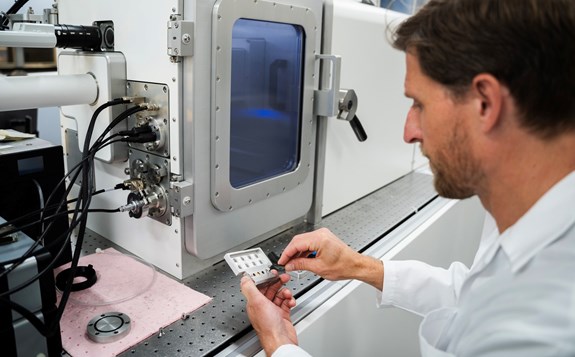
Vinther Sörensen carried out experiments at MAX IV, an advanced X-ray facility for materials and life science research.
“We observed that TMAO affects the electronic energy level in the water molecule, which changes when the osmolyte interacts with it. This is linked to the two phases of water, where our hypothesis is that TMAO increases the amount of LDL whilst urea increases the amount of HDL,” explains Vinther Sörensen.