
Environmental report 2025
Foreword from the Vice-Chancellor
Environmental issues affect us all and permeate all of Malmö University's activities. This year's environmental report provides a clear picture of the important work we have carried out in 2025 and shows how we are gradually approaching the goals set out in our Strategy 2030. By combining...
Foreword from the Vice-Chancellor
Environmental issues affect us all and permeate all of Malmö University's activities. This year's environmental report provides a clear picture of the important work we have carried out in 2025 and shows how we are gradually approaching the goals set out in our Strategy 2030. By combining environmental, social and economic perspectives, we continue to strengthen the University's role in societal transition.
The report highlights several examples of how we have reduced our environmental impact and developed more sustainable working methods – from more efficient energy use and improved waste management to systematic chemical management and sustainable procurement. Clearer requirements in procurement and better dialogue with suppliers have been crucial in driving this development forward.
Through our close collaboration with the City of Malmö – a connection formalised in May 2025 through a Climate Contract – we are contributing to sustainable development that extends far beyond the campus. This work also includes collaborations with the region and our committed students, whose initiatives play an important role in driving progress. These partnerships are one of our greatest strengths and a prerequisite for real and long-term change.
During the year, with the support of the Climate Council and the Education Committee, we conducted a review of what students in our educational programmes learn about climate change. This work has already resulted in a new higher education course focusing on the climate. It is gratifying that we can now take further important steps in our work to strengthen the climate and sustainability perspectives in education, which enhances both the quality of education and the university’s overall contribution to the transition.
I would like to express my sincere thanks to all employees and students who contribute in various ways to making Malmö University more sustainable.
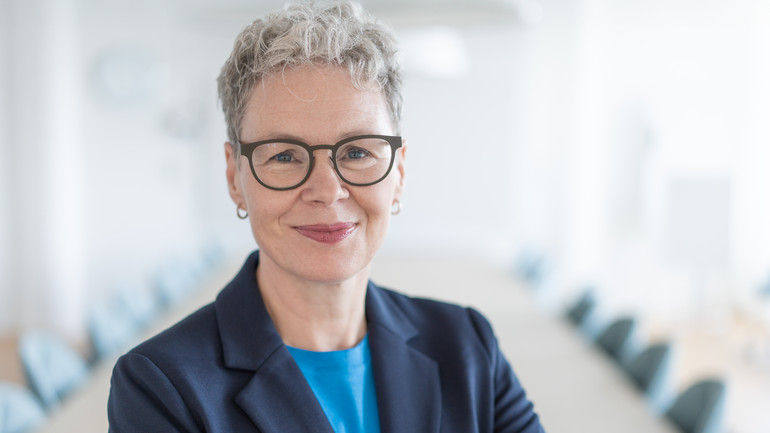
Mia Rönnmar, Vice-Chancellor
Download the Environmental Report 2025
Business travel
In short
The total number of kilometres flown has decreased by 23 per cent since the base year 2019. We are now reviewing how we can improve the conditions for sustainable travel.
How to live sustainably as a Malmö University student
A guide was created for students in Malmö, showing how to live both sustainably and in a financially smart way. The guide highlights the sharing economy through services such as Smarta kartan, where you can borrow, swap or hire items instead of buying new ones.
How to live sustainably as a Malmö University student
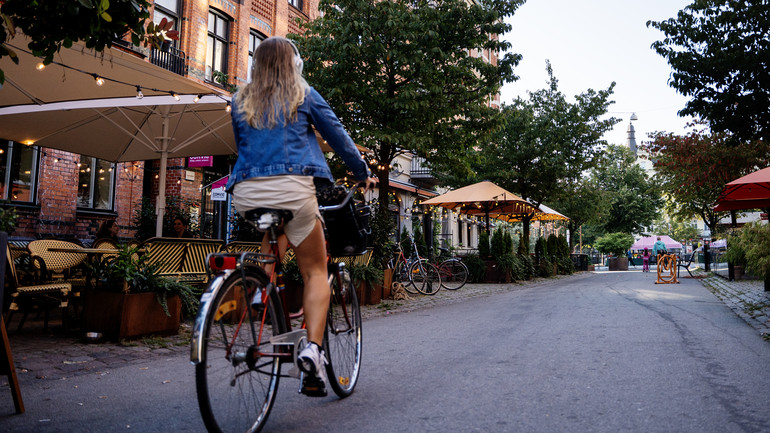
A guide was created for students in Malmö, showing how to live both sustainably and in a financially smart way. The guide highlights the sharing economy through services such as Smarta kartan, where you can borrow, swap or hire items instead of buying new ones.
There is a strong emphasis on sustainable transport; Malmö is a cycling-friendly city with good public transport and opportunities to combine cycling and train travel. Students are encouraged to repair, reuse and buy secondhand when it comes to furniture, clothes and bicycles, as well as to reduce food waste through planning, packed lunches and smart storage. The guide also shows how Malmö works with recycling, the circular economy, climate-friendly eating habits, and how nature experiences and community life can contribute to a sustainable and socially rich student life.
In short
The groundwork has been laid for a more structured approach to the reuse of furniture and furnishings.
Work towards this target involves both energy efficiency measures and installations for on-site energy generation. As a result of these measures, energy consumption in 2025 will be 8 per cent lower than in the base year of 2019.
Supplying the campus with renewable energy is a key focus of our environmental work for our properties. All energy contracts therefore include certified renewable energy. In 2025, a new contract was signed for allocated district heating for those properties where Malmö University has its own heating contract. Since 2024, the complete solar panel installation at Orkanen has been in operation. Total production in 2025 was 233,350 kWh, which corresponds to approximately 12 per cent of the property’s electricity consumption.
The University has continued to consolidate its premises. In total, the leased area has decreased by approximately 12,000 square metres since 2023.
Reused furniture
We aim to work with re-use when changes are being made in premises. This year’s most extensive project has been the redevelopment of the study environment in Orkanen, where work will continue into 2026 and reused items will play a central role. In the autumn, we began using a digital service for furniture inventory for a smarter and more sustainable working process. The service makes inventorying more efficient, provides a better overview, facilitates the reuse of furniture, and also calculates the CO₂ emissions for each piece of furniture.
Climate contract with the City of Malmö
In May, Malmö University signed the Malmö Climate Contract, a joint commitment under which the city and local stakeholders are working together to improve the strategies for tackling climate change. Through this contract, the University aims to strengthen its role in the city’s sustainability...
Climate contract with the City of Malmö
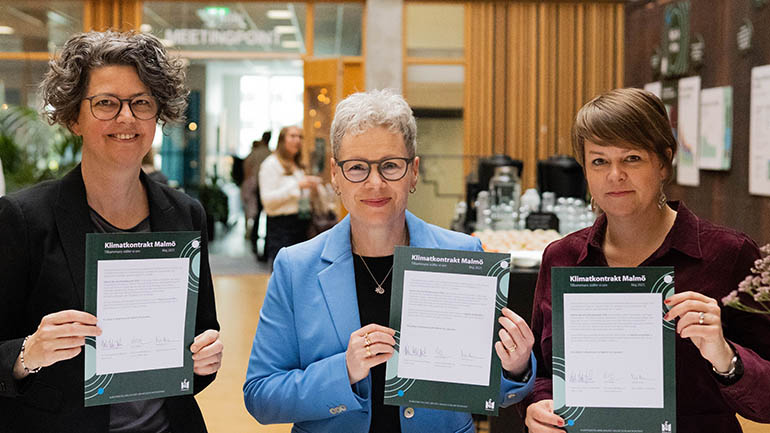
In May, Malmö University signed the Malmö Climate Contract, a joint commitment under which the city and local stakeholders are working together to improve the strategies for tackling climate change. Through this contract, the University aims to strengthen its role in the city’s sustainability efforts and contribute through research, education and the involvement of students and staff.
“Our University has a long history of collaboration with the city, and we believe that the Climate Contract can both strengthen existing partnerships and open new doors for collaboration with stakeholders in the private, public and voluntary sectors,” says Mia Rönnmar, Vice-Chancellor of Malmö University.
The University already has a systematic approach to environmental and climate work with clear targets, but many of these targets require broader collaboration to be achieved.
“Our aim is to continue making climate-related research accessible and to contribute to the public dialogue on climate transition. We therefore see the Malmö Climate Contract as a platform for collaboration and dialogue,” says Mia Rönnmar.
The photo shows Sofia Hedén, Chair of the Environment Committee (City of Malmö), Mia Rönnmar and Katrin Stjernfeldt Jammeh, Chair of the Municipal Executive Board (City of Malmö).
In short
Malmö University can now offer employees and students several options for training in chemical safety.
Previous work towards environmental goals to phase out hazardous chemicals has continued during the year, which has led to several new initiatives. Before particularly hazardous substances are used, an investigation is always conducted to ensure that their use is necessary, safe, and that no better alternatives exist.
Tests conducted in 2024–2025 showed that mops and micro cloths can be washed without any chemicals, and we have fully implemented this in one property. Ultra-pure water is now used more often for cleaning and washing, which reduces both chemical consumption and the amount of plastic packaging.
As of autumn 2025, a digital training course is mandatory for employees and students working with allergenic substances. A new course in chemical safety is aimed at employees and students working in labs, clinics and workshops.
Global certification ensures more sustainable laboratories
The chemistry laboratories at Orkanen have been certified at the highest level under My Green Lab – an internationally recognised standard for sustainable laboratories. The certification, which was awarded in November 2025, confirms Malmö University’s efforts to reduce the environmental impact of...
Global certification ensures more sustainable laboratories
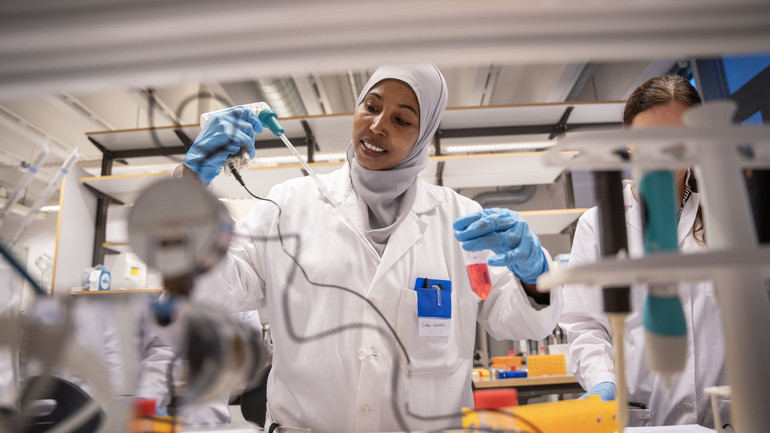
The chemistry laboratories at Orkanen have been certified at the highest level under My Green Lab – an internationally recognised standard for sustainable laboratories. The certification, which was awarded in November 2025, confirms Malmö University’s efforts to reduce the environmental impact of laboratory environments.
The certification process began with a comprehensive self-assessment and recommendations from My Green Lab. This was followed by a systematic effort to implement changes without disrupting day-to-day operations.
“Orkanen’s laboratories have been assessed in several key areas, such as energy efficiency, water conservation, waste management, and chemical useage,” says Karolina Härnström Aloisi, environmental and chemicals coordinator at Malmö University.
The aim is now to inspire more laboratories within the University to certify their operations.
The My Green Lab certification is recognised by the UN’s ‘Race to Zero’ campaign and is seen as an important step towards a more sustainable and carbon-free future.
In short
We are phasing out paper cups and replacing liquid soap dispensers with foam soap dispensers.
By 2025, residual waste has decreased and is now lower than in 2022. At Orkanen, the target (a 48 per cent reduction) has been achieved, and Allmänna Sjukhuset is close to the target (a 41 per cent reduction). Niagara stands out as a building with an 18 per cent increase. An investigation has been launched to determine why the properties are yielding such different results.
In the seventh floor staff room at Niagara, disposable cups were replaced with porcelain mugs in the autumn of 2024, resulting in 70,000 paper cups annually not being discarded. This year, we have carried out the same action in regard to the paper cups used by catering services. We have replaced liquid soap dispensers with foam soap dispensers, providing more doses per bottle. As a result of the change, around 120 plastic bottles have been saved.
More climate-related knowledge for students
A report from Malmö University’s climate council shows that climate issues are often dealt with only superficially in the University’s degree programmes, and are rarely linked directly to specific subject areas. At the same time, the faculties have expressed a clear desire to strengthen the climate...
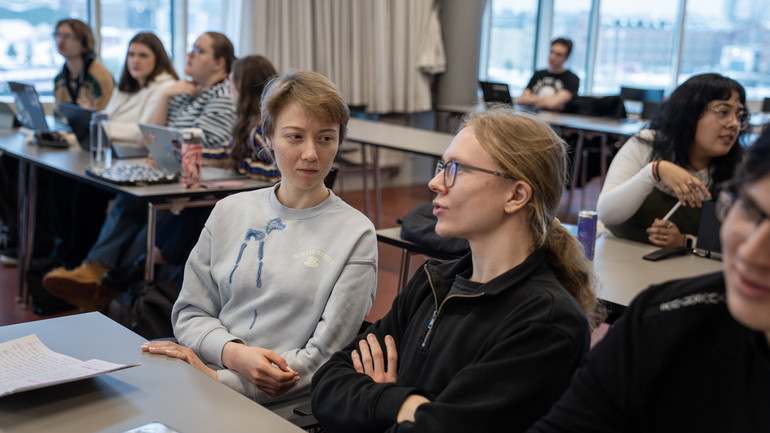
More climate-related knowledge for students
A report from Malmö University’s climate council shows that climate issues are often dealt with only superficially in the University’s degree programmes, and are rarely linked directly to specific subject areas. At the same time, the faculties have expressed a clear desire to strengthen the climate perspective and develop more relevant content for students.
“There are climate-related elements in some programmes, but to varying degrees. Often the climate issue is addressed in general terms rather than being linked to the subject,” says Helen Hasslöf, the author of the report.
Several departments are in favour of introducing an optional course with a scientific foundation that can provide students with a solid grounding.
“There is an urgent need to integrate climate-related knowledge into undergraduate programmes. The University possesses a broad range of expertise that makes it possible to develop interdisciplinary content,” says Per Schubert, chair of the Climate Council.
The report is based on analyses of syllabuses and interviews with programme coordinators, lecturers and students, and includes recommendations on how the climate perspective can be strengthened in the future.
In short
More used computers, monitors, mobile phones and tablets are collected every year. IT deliveries are made weekly using fossil-free transport.
Reclaiming IT equipment is an important part of our environmental work. The internal statistics are now pointing upwards – more and more computers, mobile phones and tablets are being returned. These devices can be used elsewhere or recycled.
In addition to these targets, Malmö University has also worked to reduce emissions in the delivery of IT equipment. Consolidated weekly deliveries, transshipment to smaller vehicles in Malmö, and unpacking before transport are examples of measures. Since the beginning of 2024, IT deliveries have been made with fossil-free transport.