FACULTY OF CULTURE AND SOCIETY | Dissertation defence
Dissertation defence – Sara Gottschalk
Friday 24 April, 13:00 - 17:00
Niagara auditorium B2, Nordenskiöldsgatan 1
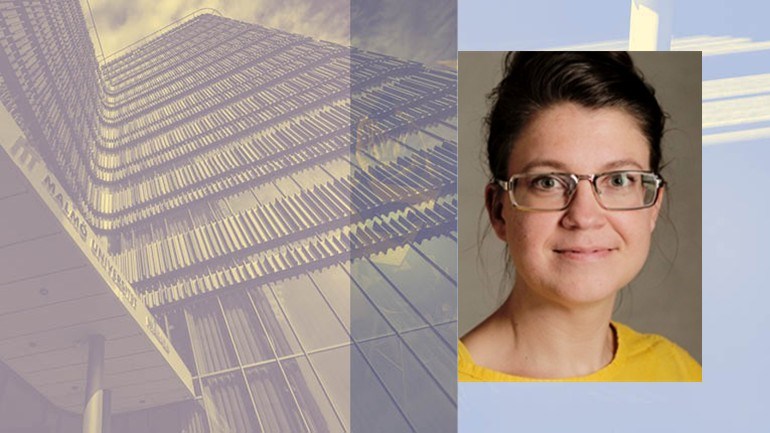
Welcome to Sara Gottschalk's dissertation defence. Sara is a doctoral student at the School of Arts and Communication at the Faculty of Culture and Society. The defence is open to all and no registration is required.
Title of the dissertation
Controversies of urban transition – thickening urban sustainable planning processes through design
Faculty opponent
Associate Professor Joanna Saad-Sulonen, Aalto University, Finland
Examining committee
- Professor Per-Anders Hillgren, Malmö University, Sweden
- Professor Lara de Sousa Penin, Parsons The New School of Design, USA
- PhD Maria Göransdotter, Umeå Institute of Design, Umeå University, Sweden
- Professor Thomas Binder, Center for Climate Research, IT University of Copenhagen, Denmark (reserve member)
- Associate Professor Christina Lindkvist, Malmö University, Sweden (reserve member)
Public defence chairperson
Professor Maria Hellström Reimer, Malmö University, Sweden
Diva
Abstract
This thesis investigates how design can contribute to democratic and eco-socially just urban transitions through long-term, place-based, and practice-based interventions. The research is executed as a designerly engagement with a real-world case of planned urban development for sustainability transition, the Sege Park project, in Malmö, Sweden. The development project is a municipally led project that explicitly seeks to experiment with new approaches to sustainability beyond conventional urban planning practices. The research draws on civic participatory design, design for transition, metadesign, and degrowth-oriented perspectives and approaches urban development for transition as a complex, multi-dimensional design process in which sustainability is continually negotiated, contested, and materialised, across actors, institutions, temporalities, and scales.
The central contribution of the research programme is the articulation of the concept of thickening as both a methodological and ontological orientation for design research. This concept initially emerged as a response to the empirical complexity of the case, but during the implementation of a layered methodological approach, (combining a case study methodology with ethnographic inquiry, design mapping, observant participation, design interventions, and retrospective analysis) the conceptual idea of thickening grew into a broader, ontological approach engaging with the real world as “thick”, inhabited, relational, and constantly in-the-making.
Empirically, the thesis contributes insights into planned urban development for transition by understanding it as a distributed design practice. It shows how municipal civil servants are engaged in designerly practices of urban transition but also in frequent socio-material infrastructuring efforts to align the municipal vision of sustainability transition among a wide range of actors, including municipal departments, developers, civic initiators and resident, so as to make sure that the vision materialises – and ultimately that an institutioning of more ambitious urban transition practice can take place. This distribution of responsibilities for urban transition across sectors and actors both enables and challenges democratic and socially just transitions. Additionally, the research highlights the strategic role of civic actors as groundbreakers and long-term anchors for transition.
A further contribution concerns the role of the “designer–researcher” in planned urban transition. By working through a dual position of doing research into design and research through design, the thesis elaborates how attention to place-based controversies inherent to urban transition processes can provide openings for designerly interventions. In the research work, two forms of intervention were experimented with: the “controversy walks” and a study circle for homemaking stewardship as a seed for change. These interventions demonstrate how design can allow residents to collectively reflect organise, and build capacity for longer-term transition processes.
At a meta level, the thesis argues that design research focused on democratic and eco-socially just transitions requires continued engagement in real-world, complex cases, as well as the continued development of a thickening design research practice.