Sovereignty without territory

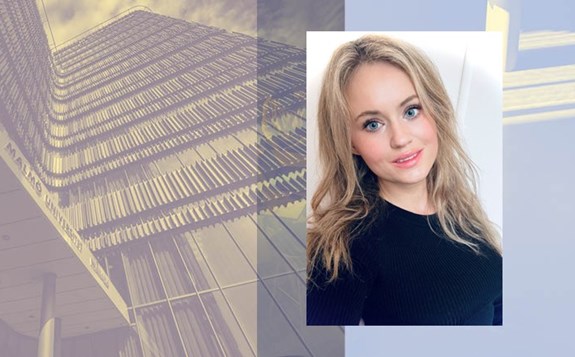
Jade McGlynn is an author and research fellow at the Department of War Studies, King’s College London.
After several years under occupation, the people of eastern Ukraine are still able to mount various forms of resistance against the authorities. On Tuesday 17 March, researcher Jade McGlynn from King’s College London will visit Malmö University to give a lecture entitled ‘Sovereignty without Territory’.
McGlynn describes how political legitimacy and Ukrainian sovereignty are supported in various ways by the people in the occupied areas of eastern Ukraine; she has taken an interest in the specific ways in which they act. This might involve, for example, sending coordinates to the Ukrainian army so that it can bomb military targets.
“It is a signal that people continue to believe in Ukrainian sovereignty over these areas,” says McGlynn.
Other ways may be less obvious, such as continuing to study at Ukrainian universities online, or using a VPN to access Ukrainian websites or news.
“There are various ways for people to express not only their Ukrainian identity but also their faith in the legitimacy of Ukrainian institutions. I believe this can be interpreted as a form of continued belief in Ukrainian sovereignty over these territories.”
Associated with great risks
Resistance is associated with great risks. As witnessed in 2026, conditions in the occupied territories have hardened quite dramatically, according to McGlynn. Open resistance is virtually impossible and takes place primarily underground. Russia has built up a very extensive control system involving digital surveillance.
20,000 children have been abducted, and Russians are being moved in through resettlement programmes. Teaching in Ukrainian has been banned since September 2025 and thousands of civilians from occupied territories have been imprisoned for extremism, which can mean simply holding a vaguely pro-Ukrainian stance, according to McGlynn.
Various signs of Russification
She sees the sending of children to various programmes and military camps as the most obvious example of Russification. Different areas have had different experiences: while the occupation of Mariupol happened very quickly and was extremely harsh from the outset, similar events have taken place more recently in the occupied parts of Kherson.
“Many districts have been given new names. I would say the clearest memory of Russification will be all the mass graves, particularly in Mariupol, which are often covered in concrete. In Primorsky Park in Mariupol, a bust of Pushkin has been placed over a mass grave containing civilians,” says McGlynn, who works at the Department of War Studies at King’s College London, where she conducts part-time research on, among other things, Russia’s war in Ukraine.
Life goes on
“Life in Kharkiv is more or less normal. Of course, there are many bombed-out buildings and closed shops. When I was there, the air defences seemed to be working again. Kharkiv is so close to the border that it’s naturally harder to defend against incoming artillery. But you can still get your nails done and go out for a nice meal!
“Life goes on inside the city, but if you head out onto the ring road, there are lots of fortifications and drone nets, and in the countryside, you immediately see far more destroyed villages,“ she adds. McGlynn believes the war will continue, arguing that European countries are not doing what is necessary to deter Russia from further aggression or to support Ukraine to the extent the country needs.
“It’s not certain, but one lesson to be learnt from the occupied areas is, unfortunately, that there is a reasonable likelihood we will have to learn that lesson for other European countries that Russia may try to attack or occupy.”