We use cookies on this website. Cookies help us deliver the best experience on our website. Read about cookies.
-
- Education
- Education
- Find programmes and courses
- Applications and admissions
- Tuition fees
- Scholarships
- Exchange studies at Malmö University
- Study Guidance
-
- After admission
- After admission
- Moving to Malmö
- Pre-orientation
- Arrival guide
-
- About studies at Malmö University
- Why choose Malmö University
- Understanding university studies
- Connect with our students
On the page -
- Research
- Research
- Find researchers and research
-
- Doctoral studies
- Doctoral studies
- Doctoral courses
-
- Doctoral schools
- Doctoral schools
- Adaptation of urban space through sustainable regeneration
- Culturally Empowering Education through Language and Literature
- Doctoral school: DACHE
- Education, Learning and Globalisation
- Finding ways in a time of great future challenges (FinnFram)
- Swedish National Graduate School in Science and Technology Education Research
- Learning in Multicultural Societal Contexts
- Pedagogy and Vocational Skills
- Relevancing Mathematics and Science Education (RelMaS)
- Sustainable Movement Education
- The National Research School for Professionals in Social Services
- Research subjects
-
- Research centres
- Research centres
- Biofilms Research Centre for Biointerfaces
-
- Citizen Health
- Citizen Health
- Kids in Action
- Imagining and Co-Creating Futures
- Institute for Urban Research
- Malmö Institute for Migration Studies
- Literacy and Inclusive Teaching
- Centre for Work Life Studies
- Sustainable Digitalisation Research Centre
- Centre for Sexology and Sexuality Studies
-
- Research publications
- Search for research publications in Diva
- Malmö University Press
- Research events
- Participate in a research study
On the page -
- Collaboration and Innovation
-
- Levels of collaboration
-
- Local collaboration
- Muvah
- Co-Create Malmö
- Regional collaboration
- National collaboration
-
- International collaboration
- UNIC
- Innovation
- Collaboration with students
-
- Collaborate with researchers
- Labs and facilities
- Culture collaboration
- Support Malmö University
- Alumni & Friends
- Malmö möts
On the page -
- About us
- About us
-
- Faculties and departments
-
- Faculty of Culture and Society
- Department of Global Political Studies
- School of Arts and Communication
- Department of Urban Studies
-
- Faculty of Education and Society
- Department of Childhood, Education and Society
- Department of Sport Sciences
- Department of Culture, Languages and Media
- Department of Natural Science, Mathematics and Society
- Department of Society, Culture and Identity
- Department of School Development and Leadership
- The Centre for Teaching and Learning (CAKL)
-
- Faculty of Technology and Society
- Department of Computer Science and Media Technology
- Department of Materials Science and Applied Mathematics
- Faculty of Odontology
- University Dental Clinic
- Management and decision-making paths
-
- Malmö University's strategy 2030
- Sustainability
- Widened recruitment and participation
- Quality assurance work at the University
-
- Malmö Academic Choir and Orchestra
- Student work – video pieces
-
- The University in a troubled world
- Campus total defence
On the page -
- Contact
- Contact
- We'll help with your questions
-
- News and press
- News and press
-
- Graphic manual
- Graphic manual
- Logo
- Colours
- Typography
- Visual language
- Film and live broadcasts
- Visit Malmö University
- Map of the buildings (Google Maps)
- Merchandise
- Supplier information and invoice management
- Whistleblowing
On the page
The number of applicants to Malmö University is increasing
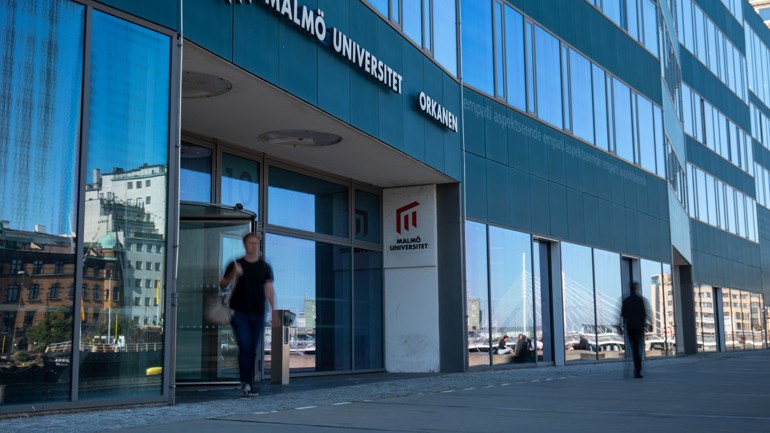
38,407 people have applied to Malmö University for studies starting in the upcoming autumn semester.
More people want to study at Swedish universities this autumn. Across the country, the number of applicants increased by 8 per cent compared to the same period last year. Malmö University’s increase stood at 6.4 per cent. Nursing is the most popular programme and among the courses, the distance course Leadership and Organisation attracted the most interest.
When admissions to autumn courses and programmes closed on 15 April, 38,407 people had applied to Malmö University. For the previous autumn semester, this figure stood at 36,095.
A university that wants to be at the forefront needs to have a good range of distance courses.
Maria Appelqvist
"This feels good and is further proof that we offer interesting and attractive programmes of good quality. It is also gratifying to see how our courses are developed on the basis of current research and that we can thus make the best possible contribution to the development of society," says Mats Edenius, pro-vice-Chancellor at Malmö University.
As in the corresponding application round last year, nursing, social work and dentistry attract the most applicants to programmes.
In terms of courses, the distance learning course Leadership and Organisation stands out. This course is offered both remotely and on-site, but the distance course is the most popular. It was offered in this format for the first time in autumn 2023, and the number of applicants has doubled for the autumn round.
“We have worked hard to create an effective online programme with pre-recorded lectures followed up with Zoom meetings. It has been very much appreciated and the course has a good reputation. We have students from all over the country with backgrounds in different industries. We offer skills development and create the conditions for lifelong learning," says Maria Appelqvist, who is in charge of the course.
Even in second and third place, it is distance learning courses that attract applicants, a sign of the times, according to Appelqvist.
"A university that wants to be at the forefront needs to have a good range of distance courses. The pandemic changed a lot, and we see a great demand in these courses.”
Across Sweden, a total of 406,000 people applied to higher education institutions for the autumn of 2024. This is a significant increase compared with 2023, when the number of applicants was 375,000.
"The fact that interest in higher education is increasing is not unexpected," says Andreas Sandberg, acting head of department at the Swedish Council for Higher Education.
He points to the deterioration of the labour market and the possibility of transitional study support for people in the middle of their working lives as two reasons why more people are choosing to apply for higher education.
Text: Cecilia Lindberg and Adrian Grist
Share Article