She’s back after a year "in space"
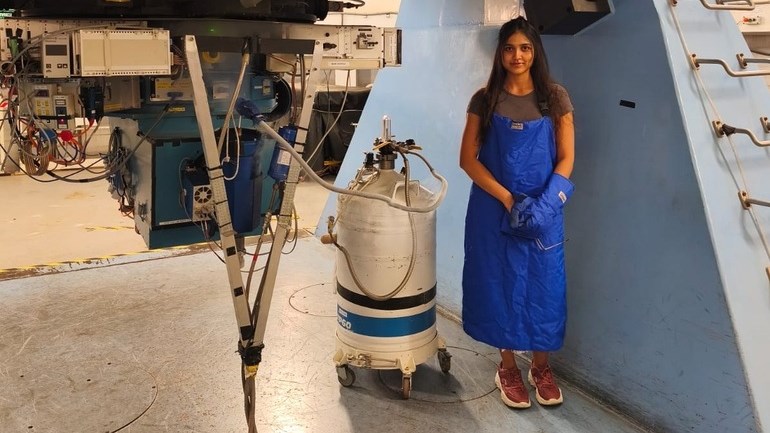
At night, Shilpa Bijavara Seshashayana was solely in charge at the station, where her duties included ensuring that the liquid nitrogen needed to keep the telescope cool was topped up.
For the past year, astrophysicist Shilpa Bijavara Seshashayana has been conducting space observations and operating the instruments at the Nordic Optical Telescope on the Canary Island of La Palma.
“Every night of observation began with a drive from the coast up to Roque de los Muchachos, which lies 2,500 metres above sea level. I would arrive late in the afternoon and prepare the telescope for the night ahead – I was responsible for the observations and the instruments,” says Bijavara Seshashayana, a PhD student in astrophysics at Malmö University.
In the constantly changing weather, the shifting air and the unpredictable atmosphere, the planet seemed fragile, almost in a frightening way.
Shilpa Bijavara Seshashayana
The Nordic Optical Telescope (NOT) was built on the initiative of the Nordic countries and gives priority to researchers from the Nordic region. The telescope’s high altitude means that starlight and infrared photons reach the instruments with less interference. Cloud cover is usually below the telescope, which minimises atmospheric interference and reduces the number of water molecules that might otherwise disrupt observations.
For around five nights each month, she was solely responsible for the instruments at the station, where her duties included topping up the liquid nitrogen needed to keep the telescope cool.
“There are neither kitchens nor toilets there, so I had to go out to a separate service building. Every night I went out under a sky so clear that the Milky Way flowed over me like a living river of light.”
Bijavara Seshashayana spent 70 per cent of her time on La Palma working on her PhD thesis, which is due to be completed this autumn. As a PhD student in astrophysics, she uses high-resolution stellar spectroscopy to explore the galactic chemical evolution of various elements, primarily by studying so-called open star clusters.
She says that the year on La Palma has given her invaluable knowledge of how to plan observations, collect astronomical data and understand how other researchers work. But that the greatest experience and insight lay on an existential level.
“In the constantly changing weather, the shifting air and the unpredictable atmosphere, the planet seemed fragile, almost in a frightening way. Something that made its beauty seem linked to its vulnerability. The focus was science, of course, but at the same time it felt like being in a dream,” says Bijavara Seshashayana.