Understanding an ageing world
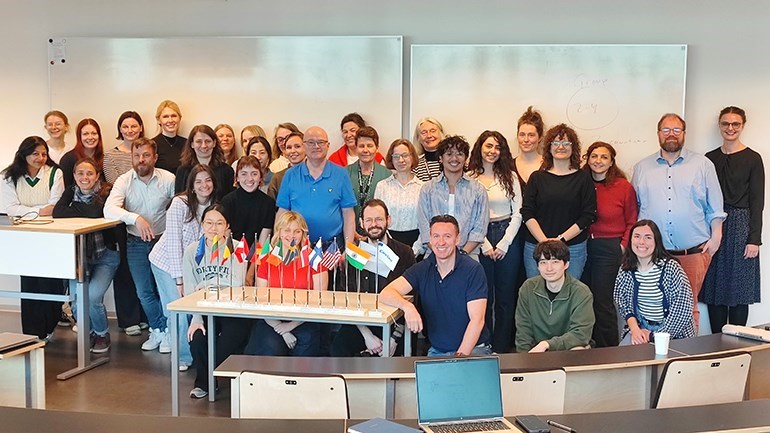
Associate Professor and Senior Lecturer Jonas Christensen (middle) with 30 course participants in ”Challenges in Ageing societies – Health, Care work, Technologies and Ethics”. Photo: Johan Portland
How do we prepare tomorrow’s researchers for a world in which populations are ageing, societies are becoming increasingly globally interconnected, and social realities are simultaneously growing more complex? An ongoing international doctoral course on ageing and societal change offers a compelling answer to the role that cross-border pedagogical encounters can play, while also serving as an example of what the future of doctoral education may look like.
The course Challenges in Ageing Societies – Health, Care Work, Technologies and Ethics brings together doctoral students from 13 countries and 16 higher education institutions. The participants represent a wide range of academic disciplines and research topics spanning the social sciences, natural sciences, and medicine. From the outset, the course demonstrates a clear ambition, not merely to transmit knowledge, but to create an environment in which researchers learn from one another through challenge-based learning across both national and disciplinary boundaries. Now offered for the third time, the course has been developed through international collaboration and forms part of an integrated knowledge environment (CareSam) that fosters both cross-faculty cooperation and partnership-based collaboration.
A classroom without borders
One of the course’s most distinctive strengths is its international character. Participants come from different parts of Europe and represent disciplines such as health sciences, sociology, political science, and psychology. As a result, questions relating to ageing are not approached from a single perspective, but rather understood as a complex societal phenomenon.
This creates something more than simply a course module; it also builds networks. For many participants, this is the first time they have engaged with researchers outside their own discipline, university, or country. Such experiences may prove highly significant long after the course has concluded, particularly in relation to future collaborations and research projects.
Learning through practice
Pedagogically, the course is grounded in challenge-based learning and a problem-oriented approach. Rather than merely attending lectures, doctoral students actively engage with their own research projects. They write, discuss, argue, and continuously relate the course content to their own research questions.
This constitutes a clear strength of the course. When the content is directly connected to participants’ doctoral work, learning becomes both more relevant and more motivating. At the same time, participants develop important skills, not only subject-specific knowledge, but also the ability to analyse, reflect upon, and communicate research.
One particularly appreciated element is the series of argumentation exercises, which challenge participants to think critically and articulate their ideas clearly. Such activities cultivate not only academic reasoning, but also the researcher’s role within a broader societal dialogue.
A course aligned with future’s university
From a broader perspective, the course is closely aligned with the ambitions that characterise contemporary higher education. It combines:
- internationalisation
- interdisciplinarity
- societal relevance
- student-centred learning
This makes it a concrete example of how strategic educational goals can be translated into practice. Particularly evident is the emphasis on understanding societal challenges, such as an ageing population, from multiple perspectives simultaneously.
Educating researchers for a changing world
At a time when demographic change affects everything from welfare systems to everyday life, there is a growing need for researchers who can think broadly, collaborate across boundaries, and understand complex interconnections.
This course demonstrates that it is possible to create precisely that kind of learning environment, not by simplifying reality, but by embracing its complexity.