
Diversity database
Introduction
Diversity and Inclusion Data: A Way of Measuring and Understanding Realities in Sweden
Diversity and Inclusion Data: A Way of Measuring and Understanding Realities in Sweden
Superdiversity captures today’s demographic complexity, where within‑group variation and intersecting social, legal and economic factors shape inequality and belonging. Understanding these dynamics requires data. Sweden’s population registers offer exceptional longitudinal coverage but cannot capture subjective identities or lived experiences of discrimination. The Diversity and Inclusion Survey fills this gap through voluntary self‑identification, enabling multidimensional analyses of inclusion and exclusion. In combination with register data, it supports more precise empirical work on superdiversity and the shifting contours of belonging in contemporary Sweden. Authors: Sayaka Osanami Törngren and Pieter Bevelander
Visualisation by Noel Grunander

Visualisation by Noel Grunander
Language, discrimination and belonging
When Language Feels Like Home: The Role of Multilingualism and Discrimination for Migrants’ Belonging to Sweden
When Language Feels Like Home: The Role of Multilingualism and Discrimination for Migrants’ Belonging to Sweden
Speaking multiple languages is part of many people’s everyday lives, shaping how they relate to the world and form emotional attachments to place—attachments that can also be affected by discrimination. While previous research has linked multilingualism to both belonging and discrimination, we know less about how these factors interact. Using data from the 2025 Diversity and Inclusion Survey, this paper examines the relationship between language proficiency, multilingual identity and linguistic racism, asking how these experiences influence place belonging among migrants and their children in superdiverse Malmö. The findings show that speaking Swedish at home strongly aligns with feeling at home in Sweden, while discrimination and lower language proficiency significantly weaken this sense of belonging. Authors: Carolin Schütze and Nahikari Irastorza
Visualisation by Ida Bennrup

Visualisation by Ida Bennrup
Political participation, trust and diversity
Voting Patterns in Malmö’s 2022 Local Election: Diversity, Language Proficiency, Trust and Belonging
Voting Patterns in Malmö’s 2022 Local Election: Diversity, Language Proficiency, Trust and Belonging
This study examines electoral turnout in the superdiverse city of Malmö. It analyses how sociodemographic, sociopsychological and attitudinal factors—such as language proficiency, sense of belonging and trust—relate to participation in Swedish local elections. Turnout is higher among older voters, women, the highly educated and Swedish citizens. Among immigrants, it varies by region of birth and rises with years of residence. Differences also appear by religious identification, moderated by nativity. Voters show higher trust toward people of other backgrounds, while non‑voters report lower social distance, suggesting inconsistent patterns across measures. Voters also report stronger belonging to the city and higher language proficiency than non‑voters. Authors: Derek Hutcheson, Vanja Mosbach and Pieter Bevelander

Beyond Migration Background How Race and Religion Matter for Integration Outcomes
Beyond Migration Background: How Race and Religion Matter for Integration Outcomes
Beyond Migration Background: How Race and Religion Matter for Integration Outcomes
Sweden’s reliance on country of birth as the primary measure of inequality reflects a universalist ideology but obscures important dynamics of exclusion that are better captured by considering race and religion alongside migration background. Using new diversity and equality data from Malmö, the study shows that country of birth best explains generational and structural aspects of integration, while race is the strongest predictor of discrimination and social recognition, and religion – particularly Muslim identity – adds an additional layer of symbolic exclusion. The findings demonstrate that migration background alone provides an incomplete picture of inequality, supporting the need for multidimensional, carefully designed equality data to better understand and address exclusion. Authors: Henrik Emilsson and Magdalena Ulceluşe
Visualisation by Oscar Franzén
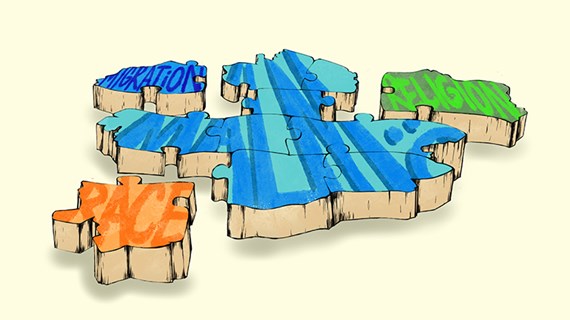
Visualisation by Oscar Franzén
Diversity capital
Diversity capital
Diversity capital
The article introduces the emerging concept of diversity capital, highlighting the individual resources that shape how people navigate and thrive in super‑diverse settings. Drawing on data from the Migration Diversity and Inclusion Survey, it examines three dimensions – attitudes, networks and competence – and their links to social trust. While the empirical findings remain inconclusive, the study underscores a pressing need for more theory‑driven approaches to understanding and measuring super‑diversity. Authors: Inge Dahlstedt, Christian Fernandez, Erica Righard

About the visualisations
The visualisations for the articles are the result of a collaboration between students in the Visual Communication program and researchers at the research centre Malmö Institute of Migration Studies (MIM), both at Malmö University.
MIM and CIMR
Malmö Institute for Migration Studies (MIM)

Malmö Institute for Migration Studies (MIM)
Malmö University’s Research Centre for Migration Studies has an interdisciplinary focus and a strong international presence. Researchers at the centre and within its extensive network develop, investigate and share knowledge on international migration and ethnic diversity.
Current Issues in Migration Research
Current Issues in Migration Research
The journal publishes a wide range of research- and practice-based articles on migration. It serves as a research platform for academics, practitioners, policymakers and the general public, and accepts articles written in both Swedish and English. Each issue contains a thematic section focusing on a specific area of research within migration and integration, as well as an open section featuring articles on issues of a more general nature.